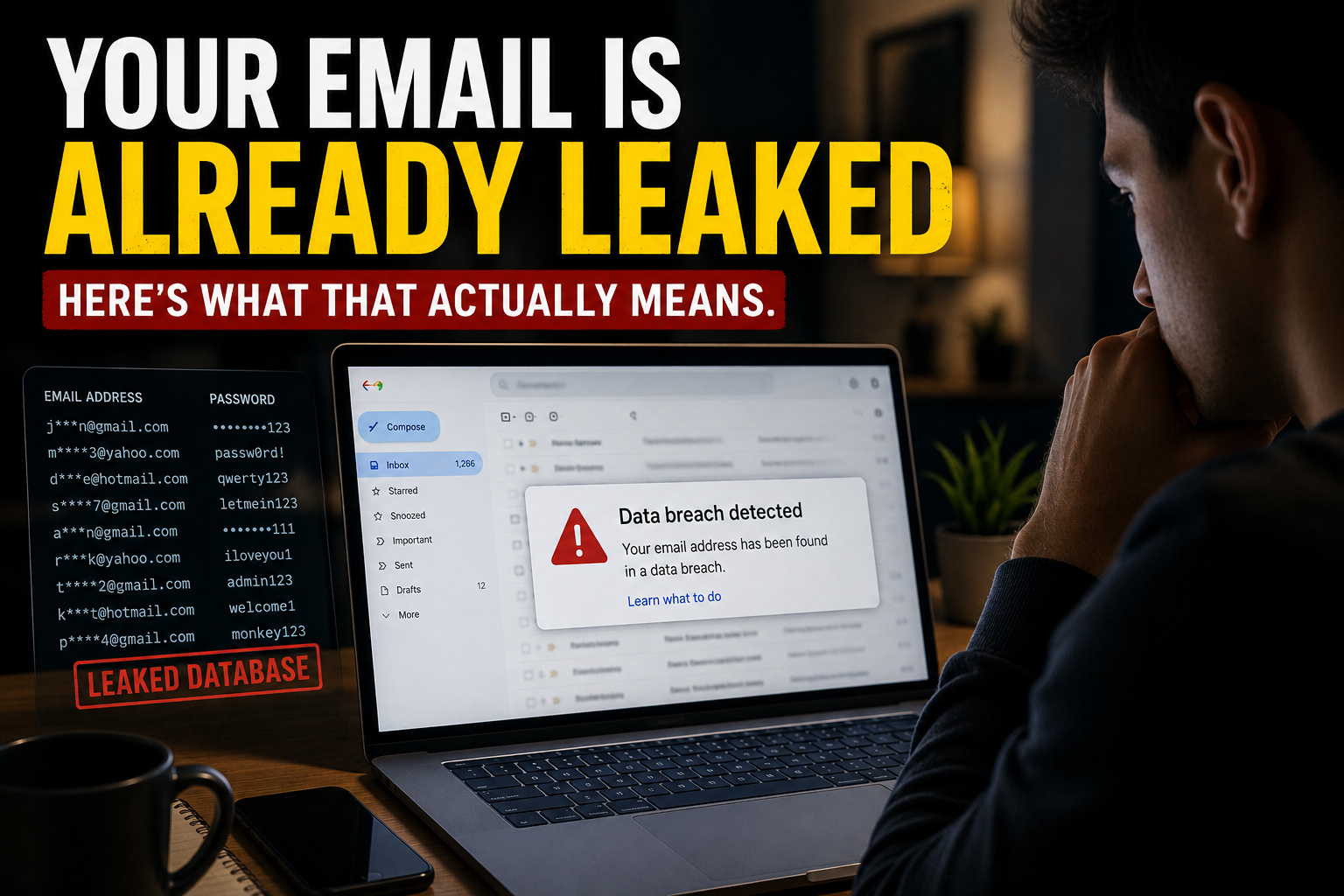
Go to haveibeenpwned.com and type in your main email address. If you've had that email for more than a few years, there's a decent chance it shows up in at least one breach. Possibly more.
I did this for the first time three years ago. My address had appeared in seven separate breaches — LinkedIn in 2012, Adobe in 2013, a couple of smaller ones I'd never even heard of. Millions of accounts each. My email, my old passwords (hashed, but still), and in some cases my name and location, floating around in databases that bad actors trade like baseball cards.
The unsettling part wasn't that it had happened. Breaches are common. The unsettling part was how little I'd thought about what I was putting at risk every time I handed my email to a random website. Each signup I'd ever done with my real address was a tiny bet that the company on the other side would keep my data safe. Some of them didn't.
This post is about understanding what your email address actually exposes, how it becomes a target, and one underused habit — using temporary email for low-stakes signups — that quietly shrinks your exposure over time.
What a Data Breach Actually Looks Like From Your End
Most people think of a data breach as a dramatic hacking event. In movies it's someone in a dark room furiously typing until a progress bar fills up. In reality, breaches are usually quieter and messier. A company leaves a database misconfigured. A developer commits credentials to a public GitHub repo. An employee falls for a phishing email and hands over access. The attackers get in, download what they can, and disappear.
The company might not even know for weeks or months. When they do find out, they're legally obligated in most places to notify affected users — but "affected users" often means millions of people getting a generic email telling them to change their password, with little else.
Meanwhile, the stolen data has usually already been packaged and sold. Not to one buyer. Leaked databases circulate. They get combined with other leaked databases — a practice called "data enrichment" in the legitimate marketing world, and "credential stuffing" when criminals do it. Your email from the 2012 LinkedIn breach gets matched with your password from a 2019 gaming site breach. Suddenly someone has a working combination they can try across your other accounts.
This is why reusing passwords is so dangerous, and it's also why your email address itself matters. The email is the username for almost everything. It's the recovery address. It's how you prove you're you. Keeping it out of breached databases in the first place is worth something.
he Specific Ways a Leaked Email Gets Misused
Not all leaked data gets used immediately or dramatically. Sometimes it sits in a database for years before anyone acts on it. But when it does get used, here's what typically happens:
Phishing at scale. Attackers know your email, sometimes your name, sometimes what services you use. That's enough to send you a convincing fake email from "Netflix" saying your payment failed, or from "Amazon" claiming there's a problem with your account. These aren't randomly targeted — they're sent to people who they already know have accounts with these services, based on breach data. The hit rate on phishing goes up substantially when the attacker already knows something real about you.
Credential stuffing. If your email and password were in the same breach, automated tools test that combination across hundreds of popular sites. Most people reuse passwords, so if your combination works on one site, it probably works somewhere else. Banking apps. Email accounts. Shopping platforms. This is why password reuse is so risky — one old forgotten signup becomes the master key.
Spam that actually knows your name. Generic spam is easy to ignore. Spam that addresses you by name, mentions a service you actually used, or references something real about you is harder to dismiss at a glance. Breach data gives spammers exactly this kind of personalization ammunition. The emails feel legitimate because they're built on legitimate information.
Selling to brokers. Not every piece of leaked data gets used directly. A lot of it flows into the data broker ecosystem, where it gets bought, sold, combined with other data, and eventually used for targeted advertising, political profiling, or resale to whoever will pay. Your email becomes a connector point — the thread that links your activity across different platforms and data sources.
How Your Email Ends Up in So Many Places
The obvious path is a breach you couldn't control — a company you trusted got hacked and your data was in their systems. That happens, and there's genuinely nothing you could have done about it once you'd given them your address.
But there are less obvious paths too.
The "we share with trusted partners" clause. Almost every privacy policy you've never read includes some version of this language. You signed up for a discount code, or a webinar, or a free PDF. In doing so you agreed to terms that allowed that company to share your contact information with their "marketing partners." Your email didn't get stolen. It got shared, legally, to people you never agreed to hear from.
The startup that sold its list. You signed up for some app two years ago, used it once, forgot it existed. The company shut down or got acquired. The acquirer now has your email address as part of the deal — and their privacy policy and practices might be very different from the original company's. You'd have no idea this happened unless you dug into the acquisition news.
Public Wi-Fi sign-in pages. Airports, hotels, coffee shops, transit systems. You've typed your email into these forms without a second thought. Some operators use legitimate vendors and delete the data quickly. Some don't. Either way, you've handed your real address to an infrastructure you know nothing about, in exchange for 90 minutes of internet access.
The forum account from ten years ago. Old forums, community sites, and small web services have a terrible track record for security. They were built before modern security practices were standard. Many are still running on old software. Many have already been breached and didn't even know it. If you made an account on something in 2009, your email is almost certainly in someone's database somewhere.
Each of these is a thread. Add them up over a decade of internet use and you have an email address that's been through many more systems than you'd consciously choose.
The Phishing Risk Is More Personal Than People Realize
There's a specific type of phishing that's become more common as breach data has gotten richer, and it's worth understanding because it doesn't look like the phishing attempts you've been trained to spot.
Traditional phishing is obvious if you're paying attention — generic greeting, suspicious sender address, urgent language, weird link. Everyone's seen the "Dear Customer, your account has been suspended" emails.
What's harder to spot is spear phishing. It uses real information about you to construct a believable message. Your name, the name of a service you actually use, sometimes even your address or employer from other breach sources. The email looks like it's from a company you have an account with, because whoever sent it knows you have an account there.
Breach data makes this trivially easy to build. If a database from a gaming site got leaked, the attacker knows exactly who has accounts there. They know the users' email addresses and possibly their usernames. They send a targeted email about that specific service. Even careful people can get caught because the message is plausible in a way generic phishing isn't.
The more places your real email address exists, the more surfaces it can be approached from. A disposable email used for one-time sign-ups means those accounts — the ones you barely care about — don't provide that attack surface. The real account isn't linked to your real email. The phisher has an address that doesn't exist.
Practical Steps for Reducing Your Email Exposure Going Forward
Make temporary email your default for anything you're not committed to. The mental model that works is this: if you don't expect to need ongoing access to an account, and you're not in a long-term relationship with the company, use a throwaway address. Free tools, trial accounts, forum registrations, newsletter sign-ups, Wi-Fi portals, coupon redemptions. All of these can use a disposable address without any downside to you.
Use a secondary permanent address as a middle layer. Some things need a real, persistent email — but not your primary one. Online shopping with stores you use occasionally. Apps you might return to. Subscriptions you actually want but don't want in your main inbox. Keep a free Gmail or similar account purely for this tier. It takes the volume without exposing your primary address.
Treat your primary email like a bank account number. You don't give your bank account number to random websites. Your primary email should have the same level of caution around it. People you know personally. Financial institutions. Healthcare. Government. Work. That's the list. Everything else has an alternative.
Check your breach exposure once and then don't obsess. Sites like haveibeenpwned.com let you see which known breaches your email appeared in. It's worth checking once so you understand your exposure. But checking repeatedly doesn't help — the data is already out there. What matters more is preventing future exposure through better habits.
Change passwords on any account where you've reused them. If your email has appeared in a breach, assume that the password from that breach has been tested against your other accounts. Change passwords on anything important, and make them unique. A password manager makes this manageable — you only have to remember one thing, and every account gets its own randomized credential.
A Note on What Temporary Email Can't Do
Being straightforward about limitations matters.
Temporary email doesn't protect you if a breach happens at a company where you have a real, ongoing account. Your bank needs your real email. Your work accounts need your real email. These are legitimate relationships and you're necessarily exposed there.
It also doesn't help if you've already handed your real address to hundreds of services over the years. The existing exposure is already there. What you're doing with disposable email going forward is stopping the bleeding, not healing the wound.
And it's not a substitute for other security basics. Strong, unique passwords are still essential. Two-factor authentication on important accounts is still important. Being skeptical of unexpected emails asking you to click something is still a skill worth having.
Disposable email is one layer in a reasonable security posture. Not the whole thing. People who treat it as a magic fix end up with a false sense of security, which can actually be worse than being aware of the real risk.
That said, as one layer, it's genuinely useful. It costs almost nothing to use. It requires no technical knowledge. And every time you reach for a throwaway address instead of your real one, you're making a small but real choice to reduce your future exposure.
The Data Broker Problem Is Bigger Than Most People Know
Even setting breaches aside, there's a quieter data problem worth understanding.
Data brokers are companies whose entire business model is collecting personal information about people and selling it to whoever will pay — advertisers, employers, landlords, political campaigns, sometimes private investigators. They're legal. They're widespread. And your email address is one of their most valuable data points because it links your activity across so many different sources.
They collect it from public records. From social media. From websites that sell or share their user lists. From other data brokers. They combine it all and build profiles. Your email, tied to your name, your approximate location, your purchasing behavior, your political activity, your health interests based on what you've searched and what health sites you've visited.
Most people have no idea this is happening because it happens invisibly, over years, in the background. You signed up for a coupon site in 2017 and that site sold its list. A data broker bought it, matched it against a retail data set, and now has a more complete picture of you than you'd be comfortable with.
Limiting how widely your real email spreads doesn't eliminate this problem. But it does slow it down. Every time a company can't connect your new signup back to your existing profile because you used a disposable address, you're slightly harder to track.
The Honest Summary
Data breaches are going to keep happening. Companies will keep mishandling email lists. Data brokers will keep building profiles. None of that is within your control.
What is within your control is how much surface area you create going forward. How many new accounts carry your real address. How many more companies end up holding your email in their database.
Using temporary email for low-stakes interactions is one of the lower-effort, higher-impact habits you can build around online privacy. It doesn't require understanding how encryption works or configuring anything technical. It just requires pausing for a moment before you type your real address into a form and asking: does this actually need to be me?
Most of the time, it doesn't. And getting a throwaway address takes about ten seconds.
That's worth something. Not everything — but something real. And for most of us, doing something real and consistent beats doing nothing while waiting for a perfect solution that never arrives.