There's a moment almost everyone has experienced: you want to download a free ebook, access a discount, or try a new app — and then comes the signup form demanding your email address. You hesitate. You know what follows. The newsletters, the promotional blasts, the "we miss you" re-engagement emails that clog your inbox for the next two years.
That's exactly the problem with disposable email services like 10Minutes. Email was built to solve. Yet despite being one of the most practical privacy tools on the internet, temp mail carries a surprisingly heavy load of myths and misconceptions. People assume it's shady, complicated, unreliable, or — in some extreme takes — outright illegal.
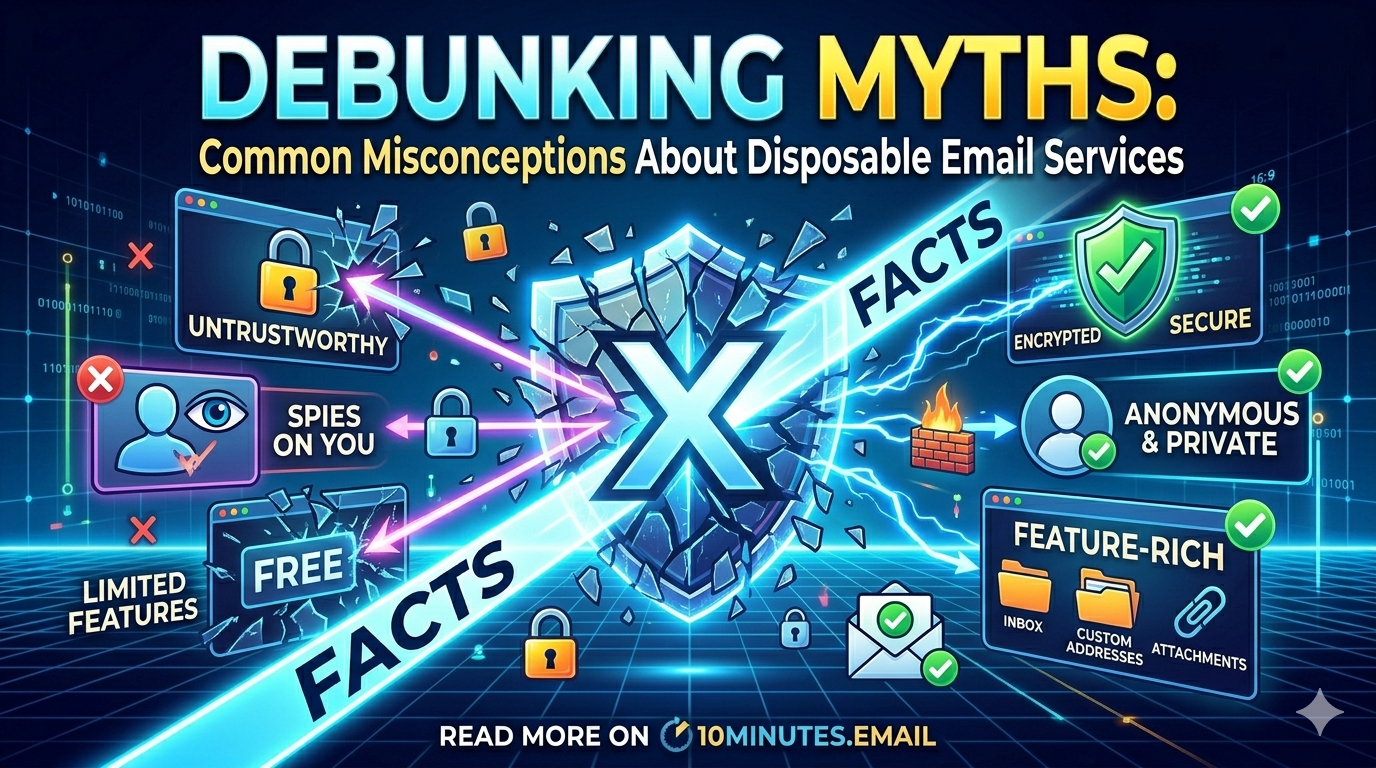
Time to set the record straight. Here are the most common myths about disposable email, debunked with facts.
Myth #1: Disposable Email Is Illegal
The Truth: Using a temporary email address is completely legal in virtually every country on earth.
This is probably the biggest myth of all, and it needs to be addressed first. There is no law — not in the US, not in the EU, not in India, not anywhere with mainstream internet infrastructure — that prohibits a person from using a temporary or anonymous email address for online signups.
What is regulated is how companies collect and use your personal data. Regulations like GDPR in Europe and similar frameworks elsewhere actually support the idea that users should have control over their own information. Choosing not to hand your primary email address to every website you visit is a perfectly rational, legal exercise of that right.
Think of it like giving a P.O. box address instead of your home address when you order something online. The product still gets delivered. Your privacy is still protected. And you haven't broken any rules.
10Minutes.Email simply provides a throwaway inbox that exists for a brief window of time. Receiving emails in it, using it to verify an account, and then letting it expire — all of that is lawful, ordinary behavior.
Myth #2: Only Hackers and Scammers Use Temp Email
The Truth: The majority of temp email users are everyday people avoiding spam.
This myth probably comes from the early days of the internet, when anonymity tools were largely associated with bad actors. But the landscape has changed dramatically. Today, the most common temp email users include:
Developers testing registration flows or email-triggered features in their applications
Shoppers who want a discount code but don't want lifetime marketing emails
Students accessing academic resources or free trials for short-term projects
Journalists and researchers registering on websites they need to review without exposing their real identity
Privacy-conscious individuals who simply don't trust every website they encounter with their personal data
A 2023 Statista survey found that data privacy ranks among the top concerns for internet users globally. Temp email is one of the most accessible responses to that concern — no technical expertise required.
The "only shady people use this" logic doesn't hold up. By that reasoning, anyone who uses an ad blocker, a VPN, or even private browsing mode must be doing something suspicious. Tools that protect personal information are for everyone.
Myth #3: Emails Don't Actually Arrive Reliably
The Truth: Modern temp mail services deliver emails almost instantly — often faster than traditional inboxes.
Earlier generations of disposable email services were genuinely unreliable. Emails would bounce, arrive minutes late, or disappear into a black hole. That reputation has stuck around long past its sell-by date.
10Minutes.Email operates on a real mail server infrastructure, not a workaround or hack. Verification emails, OTP codes, and account confirmations land in the temporary inbox in seconds. The inbox refreshes automatically, so you don't even need to hit reload.
The experience is designed to be frictionless: visit the site, get an address instantly, wait a few seconds for the verification email to arrive, copy the code, done. No registration, no password, no waiting game.
The only emails that sometimes don't arrive are those that have been blocked at the sender's end — which brings us to the next myth.
Myth #4: Temp Email Is Useless Because Most Websites Block It
The Truth: Temp email works on the vast majority of websites — and the ones that block it often have legitimate, understandable reasons for doing so.
Yes, some platforms — particularly those with subscription-based business models or free-tier abuse concerns — actively block known disposable email domains. This is a reality. But it's a much smaller share of the internet than the myth suggests.
For general-purpose use: downloading resources, accessing content, registering for tools you want to evaluate, reading paywalled articles, participating in forums — temp email works smoothly almost everywhere.
The platforms that do block it (streaming services, fintech apps, subscription SaaS products) have their own reasons tied to fraud prevention or business sustainability. That's a separate conversation about business policy, not a flaw in the temp email service itself.
Services like 10minutes.email and similar disposable mail tools continuously rotate and maintain updated domain pools, which means even on stricter platforms, options exist. The tech is always catching up.
Myth #5: It's Technically Complicated to Use
The Truth: Using a disposable email service requires zero technical knowledge and takes under 30 seconds.
People who hear "temporary email" sometimes imagine command-line terminals, custom DNS settings, or some other technical barrier. The reality is hilariously simpler.
Here's the full process for 10Minutes.Email:
Open the website.
Your temporary email address is already generated and waiting for you.
Use it wherever you need it.
Check the inbox on the same page.
Walk away when you're done.
That's it. No app to install. No account to create. No password to remember. No settings to configure. If you can open a browser tab, you can use 10Minutes.Email. It was built for simplicity — the entire interface fits on a single screen and works the same on mobile and desktop.
Myth #6: Disposable Email Puts Your Security at Risk
The Truth: Temp email reduces your exposure — it doesn't add to it.
This one requires flipping the logic. Some people worry that using a temp email service is risky because "who knows who's running it?" But consider the alternative scenario: you give your real email address to every website you visit, those sites get breached (which happens constantly), and suddenly your primary email — tied to your bank, your social accounts, your workplace communications — is floating around on the dark web.
Disposable email exists specifically to create distance between your real identity and untrusted websites. By using a throwaway address for a registration you're not sure about, you protect your primary inbox from:
Spam and unsolicited marketing
Phishing attempts targeting your real address
Data brokers who harvest email lists from breached databases
Social engineering attacks that use your email as an entry point
A throwaway inbox that expires has no meaningful attack surface. There's nothing to steal from it because it holds nothing of value — by design. The myth has it completely backwards.
Myth #7: Temp Email Means You Have Something to Hide
The Truth: Protecting your inbox is a hygiene practice, not a confession.
This is the social stigma version of Myth #2, and it deserves its own answer. Privacy is not synonymous with secrecy. Locking your car doesn't mean you're hiding something inside it. Closing your curtains at night doesn't mean you're doing something shameful. These are just sensible defaults.
The modern internet is saturated with data collection. Every email address you hand over becomes a data point that gets stored, analyzed, sold, or eventually leaked. Choosing to protect your primary inbox from that system isn't suspicious — it's savvy.
In fact, major privacy advocates, cybersecurity professionals, and digital rights organizations routinely recommend using throwaway email addresses for low-trust registrations. That's not the behavior profile of someone "hiding something." That's just good digital hygiene.
Myth #8: All Temp Email Services Are the Same
The Truth: There's a wide range in quality, reliability, spam filtering, and feature sets across different providers.
Not all disposable email tools are built equally. Some are riddled with intrusive ads. Others log your usage data in ways that undercut the privacy benefit. Some haven't updated their domain lists in years, making them easy to detect and block. A few have disappeared entirely mid-use, taking the inbox with them.
10Minutes.Email differentiates itself on a few key dimensions:
Time extension: The default 10-minute window is enough for most verifications, but if you need a bit longer, you can extend the session without creating an account.
Clean interface: The UI is stripped down to exactly what you need — your address, a copy button, and the incoming mail panel. No clutter, no dark patterns.
No registration required: Some services in this space have started requiring email signups (ironic) to access their "free" temp mail. 10Minutes.Email requires nothing.
Speed: Emails appear in the inbox within seconds of being sent. For OTPs and verification codes that expire quickly, speed matters.
Privacy-first defaults: No tracking, no data retention beyond the session, no selling your usage data.
The difference between a quality temp mail service and a poor one becomes obvious the moment you actually need it — when the OTP has a 60-second expiry window, and your inbox is still loading.
Myth #9: Temp Email Is Only Useful for Shady Free Trial Abuse
The Truth: The legitimate use cases far outnumber the questionable ones.
Yes, some people use disposable email to cycle through free trials. That's a real thing. But building the entire perception of temp email around that one use case ignores a much longer list of legitimate applications:
App development and QA testing — registering test accounts without polluting a real inbox
Academic research — accessing resources behind registration walls
Evaluating SaaS tools — trying a product before deciding to commit
Reading gated content — accessing whitepapers, reports, or articles without subscribing
Online contests and giveaways — participating without handing over a long-term marketing channel
Forum registrations — joining communities for one-time questions
Protecting a main inbox while traveling — using temporary addresses on public WiFi networks
For each of these, the person using a temp email isn't gaming the system. They're making a rational decision about what level of commitment they owe a website they're interacting with for the first time.
The Bigger Picture
Disposable email services exist because the internet made a tricky tradeoff: access to content and services was made "free" in exchange for personal data, starting with your email address. That bargain made sense once. It makes less sense now that the downstream consequences — inbox overload, data breaches, targeted manipulation — are so well understood.
Temporary email services are a legitimate, legal, and increasingly mainstream response to that tradeoff. They don't solve every privacy problem. But for the specific problem of handing your real inbox to an untrusted party, they're one of the cleanest solutions available.
10Minutes.Email keeps it simple: a real address, a real inbox, a reasonable window of time, and then it's gone. No myths required.