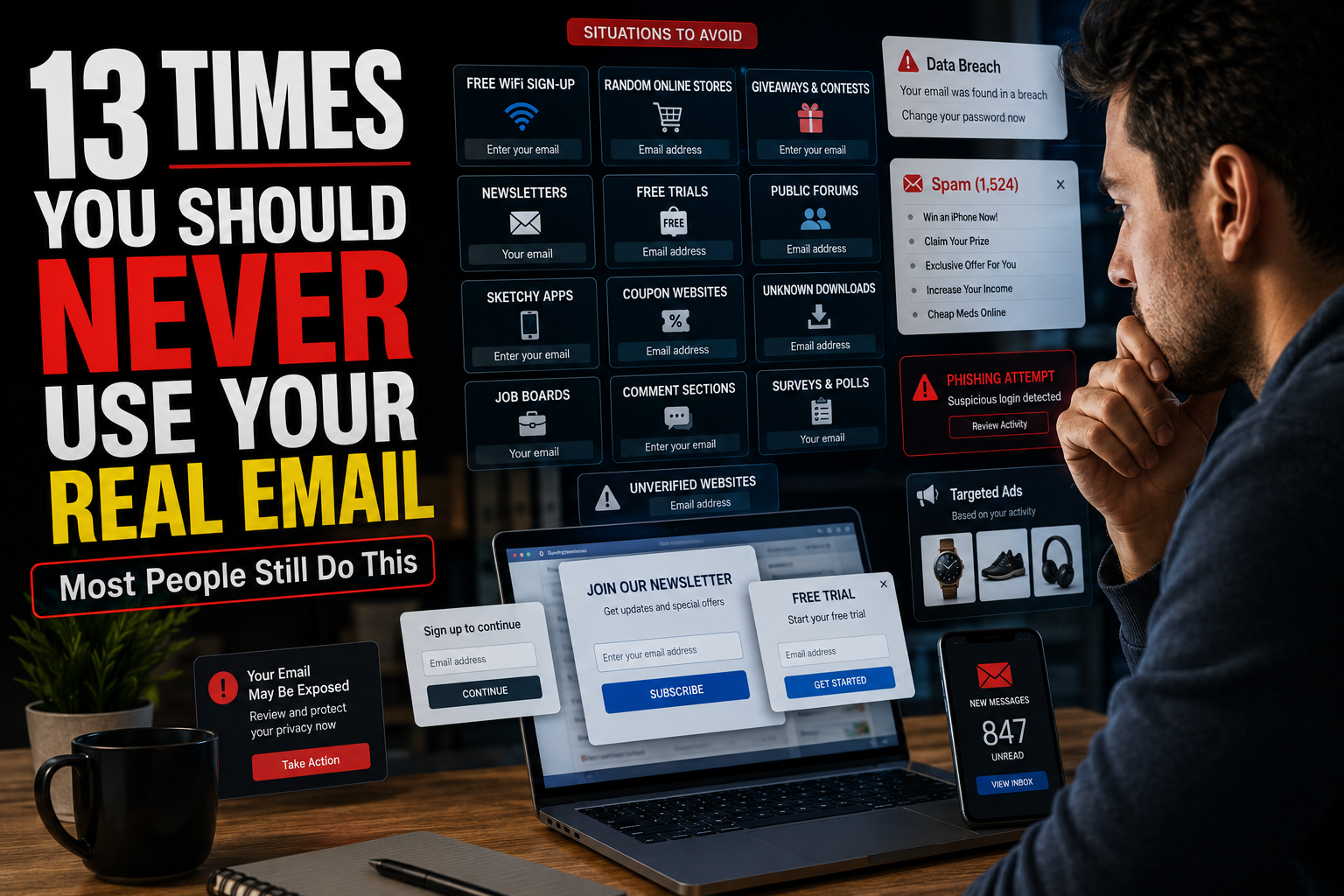
Here's a question nobody thinks about until it's too late: how many websites have your email address right now?
Go ahead and guess. Twenty? Fifty?
The average internet user has accounts on over 100 different websites. And for every account you actually created on purpose, there are probably three or four signups you don't even remember — that random quiz, that one-time coupon, that Wi-Fi login at a coffee shop two years ago.
Every single one of those is a company that can email you whenever they want, share your address with whoever they choose, and potentially leak it in a data breach. Your email address is scattered across the internet like confetti, and you can't take it back.
But you can stop adding to the mess. There are specific situations — predictable, everyday situations — where handing over your real email is completely unnecessary. I've tracked my own online behavior for months and built this list from experience. These are the 13 times you should use anything but your actual inbox.
1. Downloading a Free PDF, Template, or Ebook
This is the most common trap online. A website has a guide, a checklist, a template, or an ebook you want. Great. But to get it, you need to "enter your email below." The moment you do, you're subscribed to their marketing list. That one PDF turns into 50 emails over the next six months.
I downloaded a free social media calendar template last year. In the following 90 days, I received 34 emails from that company — product launches, webinars, partner offers, "limited time" deals. For a calendar template.
The move: Use a throwaway address. You get the download link in seconds, grab your file, and nobody follows up. The company gets a subscriber that vanishes, and you get your content without the baggage.
2. Signing Up for a Free Trial You're Just Testing
Free trials are designed to convert you into a paying customer. That's not a criticism — it's business. But the email address you provide becomes the anchor for their entire sales funnel. Even if you cancel on day one, expect onboarding sequences, feature announcements, "we miss you" emails, and re-engagement campaigns for weeks.
I've tested free trials of project management apps, design platforms, and CRM software where I had zero intention of buying. In every case, unsubscribing from their emails took more effort than the trial itself.
The move: Test the product with a non-permanent address. If you love it and decide to pay, you can always update your email to your real one later. Most platforms allow email changes in account settings.
3. Accessing Wi-Fi at Airports, Hotels, or Cafes
Public Wi-Fi login pages are email harvesting machines. The airport doesn't need your email to give you internet access — they want it for marketing and data collection. Same with hotel lobbies, coffee shops, conference centers, and co-working spaces.
These emails get shared with "partners" almost immediately. I once used my real email to log into airport Wi-Fi in Bangalore. Within 48 hours, I started receiving travel deal emails from companies I'd never contacted. Coincidence? Not a chance.
4. Entering Online Contests, Giveaways, or Sweepstakes
"Enter your email to win!" is one of the oldest lead-generation tactics on the internet. The contest might be real, but the primary purpose is building an email list. Your address will be used for marketing regardless of whether you win.
Worse, some contests explicitly state in their fine print that your email will be shared with "sponsor partners." I read the terms of a giveaway once and counted seven companies that would receive my email if I entered..
5. Commenting on a Blog or Forum for the First Time
Most blog comment systems and forum registrations require an email address for "verification." Fair enough — it reduces bot spam. But that email sits in their database permanently, even if you never comment again.
Some blog platforms sell commenter email lists to third-party marketers. WordPress sites using certain plugins store your email in databases that can be breached independently of the main site.
The move: If you're dropping a one-time comment or joining a discussion you won't revisit, there's no reason to leave your real address behind. Use something disposable and keep your inbox out of someone else's database.
6. Signing Up for a Newsletter You're Not Sure About
You see an interesting newsletter. The topic sounds relevant. But you've been burned before — you signed up for what looked like a weekly digest and got daily emails, promotional content, and "personalized recommendations" that were clearly automated spam.
I've subscribed to over 40 newsletters in the past two years. Maybe 6 of them were worth keeping. That's an 85% regret rate.
7. Creating Accounts on E-Commerce Sites You'll Use Once
You're buying a specific item from a store you'll probably never shop at again. Maybe it's a niche electronics part, a gift from a boutique store, or a deal you found through a price comparison site. The store requires an account with email verification.
Once you complete the purchase, your email lives in their system forever. Promotional emails, "items you might like" recommendations, seasonal sales — they all start flowing in. Some retailers email daily. Daily.
8. Registering for a One-Time Webinar or Virtual Event
Webinar platforms are among the most aggressive email marketers in existence. Register for a single webinar and you'll receive: a confirmation email, a reminder email, a "starting soon" email, a "replay available" email, a follow-up survey, and then ongoing emails about future events and products. That's six emails minimum from a single registration.
I registered for a marketing webinar once using my real email. Eight months later, I was still getting weekly invites to events I had no interest in.
The move: Register with an address that lets you access the event link but doesn't chain you to their follow-up sequence. Most webinar replay links are also posted publicly within a few days anyway.
9. Using Online Calculators, Quizzes, or Assessment Tools
"Calculate your mortgage rate!" "Find your personality type!" "See how your salary compares!" These interactive experiences are engaging and fun. They're also sophisticated lead generation funnels.
The pattern is always the same: you answer questions, build anticipation about your result, and then — right before the reveal — "Enter your email to see your results." Your curiosity is at peak level. You're emotionally invested. You type your email without thinking.
Now they have your email, your quiz answers, and a behavioral profile of someone willing to engage with their content. That data gets used for targeted marketing.
The move: If you want the result, use an address that won't haunt you. Or better yet, check if the result is visible without email submission — some sites show it immediately and only use the email field for optional newsletter signups.
10. Signing Petitions or Joining Online Campaigns
You care about the cause. You want to add your name. But online petitions — whether on Change.org, dedicated campaign sites, or nonprofit platforms — almost always add your email to marketing lists.
I signed a petition about local environmental policy three years ago. I still receive emails from the organization, their affiliated groups, and political campaigns that somehow acquired my address from the petition database. One signature, years of follow-up.
The move: Sign with a fresh inbox you can generate in seconds if the petition doesn't require identity verification. For petitions that do verify identity, you'll need your real details — but those are the exception, not the rule.
11. Getting Quotes or Estimates From Service Providers
Requesting quotes online — from insurance companies, moving services, solar panel installers, wedding venues, or home repair contractors — is like setting off a marketing bomb. Your email (and usually your phone number) gets distributed to multiple vendors simultaneously.
I requested a car insurance quote through a comparison site once. Within 24 hours, I received emails from 11 different insurance providers. Eleven. Some of them emailed me weekly for three months.
The move: When shopping around for quotes and you're not ready to commit to a provider, protect your inbox. Use an address that handles the initial responses, then switch to your real email once you've chosen a provider to work with.
12. Registering on Gaming Platforms or Apps You're Trying Out
Mobile games and new gaming platforms need an email for account creation. But if you're just checking whether a game is fun before committing, you don't need to hand over permanent access to your inbox.
Gaming companies are notorious for aggressive email marketing — new character releases, in-game events, "come back and play" campaigns, limited-time offers. Delete the game after a day, and the emails keep coming for months.
The move: Try the game with a throwaway address. If it becomes a regular part of your life, update the account email later. Most games let you change your email in settings.
13. Accessing Paywalled Articles With "Free Registration"
News sites, research databases, and content platforms increasingly use a "free account" model — the content is technically free, but you need to register to read it. Your email is the price of admission.
Some publications share this data with advertising networks. Others use it for internal subscription marketing. Either way, reading one article shouldn't commit your inbox to a long-term relationship.
The move: If you want to read a single article and have no intention of becoming a regular subscriber, use a non-permanent email for registration. If the publication proves valuable over time, you can always create a proper account later.
The Pattern You Should Notice
Look back at all 13 situations. They share a common thread: the exchange is uneven. You're getting something small and temporary — a file, a trial, a login, a quote, a comment, a quiz result. But in return, you're giving something permanent — ongoing access to your inbox.
That asymmetry is the whole problem. These companies gain a long-term marketing channel. You gain a one-time thing. And the cost of that imbalance — the spam, the data sharing, the breach exposure — keeps compounding every time you do it.
The Bonus Trap: Loyalty Programs and Reward Signups
This one didn't make the main list because it's borderline — some loyalty programs are genuinely worth joining with your real email. But most aren't.
Restaurants, clothing stores, beauty brands, and grocery chains all push loyalty programs at checkout. "Enter your email and get 10% off today!" The discount is real. But the flood of emails that follows — weekly promotions, partner offers, birthday campaigns, "double points" events — is the price you didn't see on the sign.
I joined a clothing store's loyalty program for a one-time 15% discount on a $40 purchase. That $6 savings cost me roughly 200 marketing emails over the following year. At some point, you have to ask whether the math makes sense.
The filter question applies here too: Will you shop at this store regularly enough that ongoing emails are welcome? If yes, use your real address. If you're just grabbing a one-time discount, handle it the same way you'd handle any other single-use signup.
Why Companies Make It So Hard to Avoid
It's worth understanding the other side. Companies collect emails because email marketing has one of the highest ROIs of any marketing channel — roughly $36 returned for every $1 spent, according to industry reports from Litmus. That's why every website, app, and checkout flow pushes so hard for your email address.
They're not being evil. They're responding to incentives. Email lists are valuable business assets. A company with 100,000 email subscribers has a direct communication channel worth real money — for marketing, for announcements, for driving repeat purchases.
But understanding their incentive doesn't mean you have to subsidize it with your own inbox. You can respect their business model while choosing not to participate in it with your primary email address. Both things can be true at the same time.
The One-Minute Habit That Fixes This
Building better email habits doesn't take hours. It takes about 10 seconds per signup.
Before you type your email into any form, ask one question: "Will I need to hear from this company next week?"
If the answer is yes — it's a store you shop at regularly, a service you're subscribing to, a contact you want to maintain — use your real email.
If the answer is no — and it will be no more often than you expect — use something that won't follow you home.
That single-question filter, applied consistently, will reduce the spam in your inbox, shrink your exposure in data breaches, and give you back control over who gets to land in your inbox. It's the simplest privacy habit you can build, and it works every time.
But What About Emails I Might Need Later?
This is the most common objection. "What if I need that confirmation email or receipt?" Valid concern. Here's how to handle it.
For download links: Save the file immediately after receiving it. The email is just the delivery mechanism — once you have the file, you don't need the email.
For verification codes: Copy the code the moment it arrives. Paste it into the verification form. Done. You don't need to store a verification code email for posterity.
For receipts and order confirmations: Screenshot them or copy the important details (order number, tracking link) before the address expires. For purchases over a certain amount, I always save the confirmation details within the first few minutes.
For event links: Save the calendar invite or bookmark the event URL as soon as you receive it. The email is just a container — the link inside it is what matters.
The goal isn't to lose important information. It's to grab what you need in the moment and not let that moment turn into a permanent relationship with someone's email list.
Your Real Email Is Your Digital Home Address
Think of it this way. Your email address is the digital equivalent of your home address. You give your home address to your bank, your employer, your doctor, and your close friends. You don't give it to every store you walk past, every flyer someone hands you, or every stranger who asks.
The same logic should apply online. Your real email goes to companies and people you trust with ongoing access. Everything else gets handled differently.
The internet trained us to be careless with our email addresses because forms make it so easy and the cost is invisible at first. Undoing that habit doesn't require paranoia or technical skill. It just requires pausing for a moment before each signup and asking: does this form deserve my real address?
Most of the time, the answer is no. And the sooner you start acting on that, the cleaner your inbox — and your digital life — will become.